How leading operators are using digital innovation to boost growth, efficiency and customer loyalty
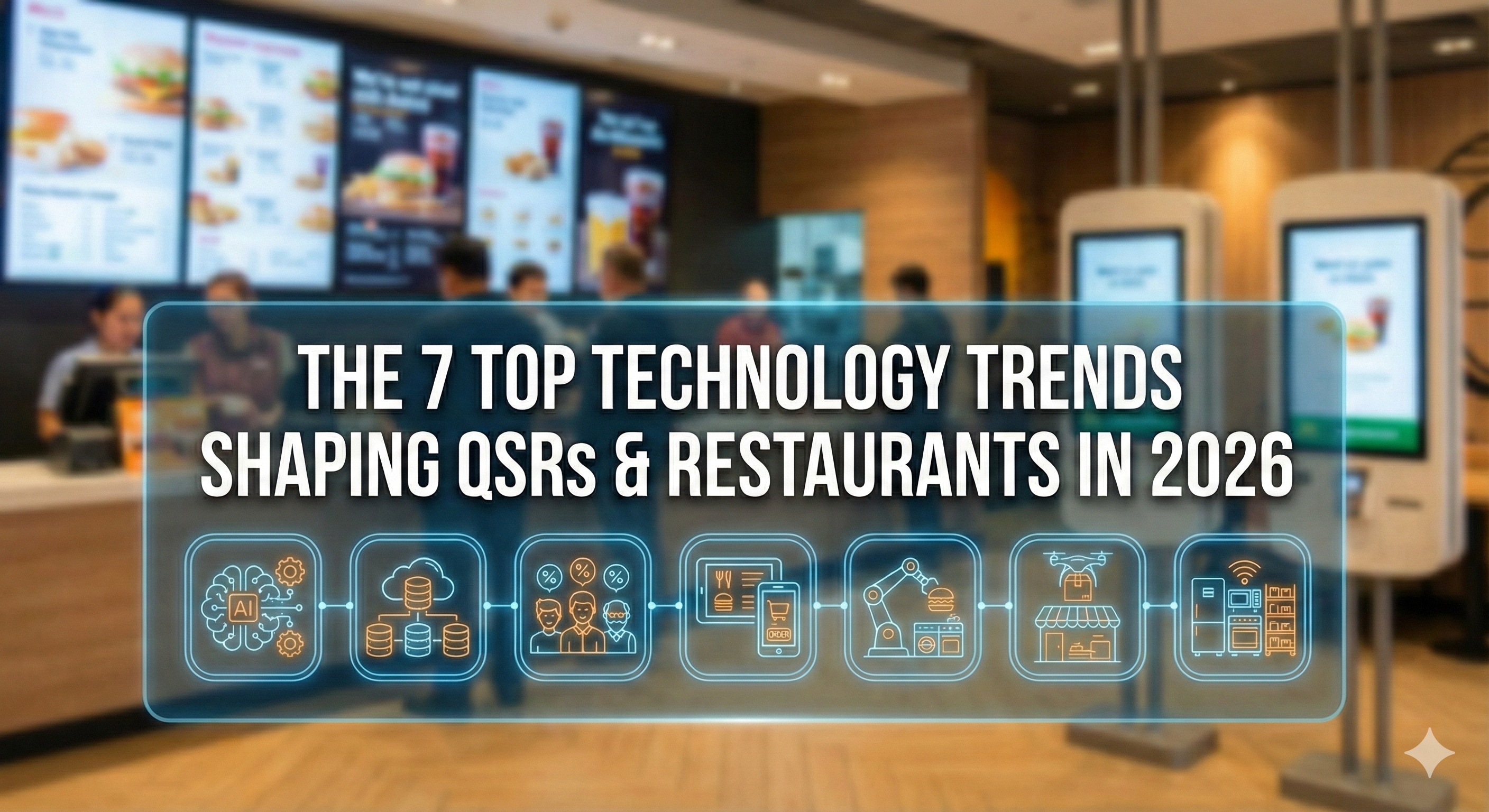
After several years of rapid change, 2026 is shaping up to be a defining year for the restaurant and QSR sector. Rising costs, labour shortages, and increasingly digital consumer behaviour continue to challenge operators across Australia, the UK and beyond. At the same time, opportunity is everywhere — for brands that invest in the right technology.
In this article, we look at the biggest technology trends shaping the industry in 2026, and how forward-thinking restaurants and QSRs can position themselves for success.
- AI: The Engine Behind Personalisation and Operational Efficiency
No surprise to see AI as the top trend – the same is true of many industries, with hospitality being no different. We see all around us that Artificial intelligence has moved from technology theory to daily practice. AI will become ever-more embedded into the hospitality sector, and in 2026, will sit behind a host of major QSR interactions:
- AI voice ordering in drive-thrus to improve accuracy and speed
- Smart menu recommendations that personalise promotions
- Predictive analytics forecasting sales, staffing needs and ingredient consumption
- Dynamic pricing and promotions that adjust based on demand
- Automated marketing triggered by customer behaviour
- Integrated Tech Stacks: Building the Data Foundation for AI
The real key to harnessing AI is having a solid data foundation. AI only works when data from different channels is connected, consistent, and centralised. In 2026, the priority for IT leaders is shifting from “how do we use AI?” to “do we have the data infrastructure that enables AI to work?”
This is where integrated technology stacks and cloud-based POS systems come into play. For growing restaurant groups and multi-site QSR brands, on-premise systems often struggle to keep up. Cloud POS now sits at the heart of the modern tech stack, connecting menu management, inventory, kitchen operations, reporting and analytics, loyalty programs, and delivery and aggregator platforms
By centralising operations and providing real-time data, cloud POS enables IT teams to:
- Manage menu updates across dozens of locations instantly
- Monitor stock levels and forecast demand
- Compare performance by site
- Deploy new features without downtime
Ultimately, cloud POS lets operators focus on turning data into insights and action, rather than spending time managing hardware or siloed software — creating the foundation that makes AI truly effective.
- The Value Revolution: Tailored Offers by Generation
Cost-of-living pressures in both the UK and Australia continue to influence diner behaviour — and in 2026, smart restaurants and QSRs will respond with compelling deals to attract footfall.
The need for offers has long been understood, but new research is showing that when it comes to the range of offers a restaurant could use to tempt diners, one size no longer fits all. So 2026 is set to be the year of the tailored offer. Research from You Gov in the UK highlights how differently the generations respond to offers:
- Gen Z: Most price-sensitive; heavy users of discounts and digital offers.
- Millennials: Motivated by savings and convenience; respond well to app-powered bundles and rewards.
- Boomers: Less driven by discounts but value happy hour, set menus and classic promotions.
In 2026, operators need segmented, data-informed offer strategies. Loyalty platforms with demographic tagging, purchase history and behavioural tracking enable personalised incentives that increase ROI and avoid discount waste.
The same YouGov survey also reports that social media has become the primary channel for discovering restaurant deals. TikTok, Instagram and Facebook are now the digital sandwich boards — where diners learn who is offering what.
This changes how QSRs market value: it must be real-time, visual, trackable and mobile-first.
Platforms that integrate POS/loyalty data with campaign tracking can finally show which social posts actually drive transactions.
- Personalised Self-Service: Kiosks, Digital Menus & Mobile Ordering
Self-service is no longer a novelty — throughout the first half of the 2020s it has become an operational cornerstone. Kiosks, QR-code menus and mobile ordering offer what guests value most: speed, control and convenience. For operators, they also reduce queues, improve accuracy and free staff from low-value tasks.
In the second half of the decade, the next wave of kiosks will be even smarter: personalised menu suggestions based on time of day, weather, prior orders or loyalty data; multi-language support; and built-in upsell intelligence that lifts average order value automatically.
To harness this trend, QSRs need a POS and ordering platform that unifies dine-in, kiosk, app and delivery channels — ensuring every order flows smoothly into the kitchen.
- Robotics & Kitchen Automation: Moving Into the Mainstream
Labour shortages and rising wages in countries like Australia and the UK are accelerating investment in automation. Hospitality is of course, fundamentally a people-driven sector, and in 2026 operators will continue to see the opportunity of using automation for repetitive, high-volume tasks, freeing up their valuable human resources to focus on customer experience.
We’ll see increased kitchen automation in the form of robotic fryers, automated drink machines, dishwashing robots and food assembly stations, integrated with POS and kitchen display systems (KDS), helping operators to:
- increase throughput
- reduce human error
- maintain consistency
- protect margins
- Delivery-First Operations: The Evolution of Ghost Kitchens
Off-premise dining remains strong, especially in urban areas. In both the UK and Australia, delivery and click-and-collect have become habits rather than conveniences.
Ghost kitchens and virtual brands provide flexibility, but only when operators can orchestrate orders across multiple channels without creating operational chaos.
This requires:
- unified order ingestion from all delivery partners
- accurate menu syncing
- intelligent kitchen routing
- real-time inventory feeds
- consistent customer data across all brands
The chains succeeding in 2026 will be those that treat delivery as a core service, not an add-on — and that rely on tightly integrated digital infrastructure to run it profitably.
- The connected kitchen: IoT and Smart Inventory
A significant squeeze on margins comes from food waste, spoilage and compliance. In 2026, operators will increasingly turn to IoT sensors and connected back-of-house systems to increase stock visibility and control, using:
- automated temperature and hygiene monitoring
- predictive low-stock alerts
- automated replenishment
- equipment diagnostics before downtime occurs
By connecting inventory, POS, supplier systems and menu management, operators will be able to reduce over-ordering and waste and ensure that in 2026, all their menus are profitable.
Conclusion: 2026 Belongs to Operators Who Connect Their Technology
The trends shaping restaurants and QSRs in 2026 aren’t isolated — they all point toward the same operational truth:
Success now depends on a unified technology stack and a digital-first restaurant ecosystem.
Whether it’s automation, loyalty, smart inventory, mobile ordering, or social-driven promotions, IT decision-makers need platforms that connect all their systems and data in a unified, accessible and manageable way.
Operators in the UK and Australia are stepping into a more complex, competitive environment — but also one bursting with opportunity.
Those who invest today in connected, data-driven systems will be the ones leading the market tomorrow.

 Steve Clement : 05/05/2026 4:36:59 PM