“We have a fractured tech stack, which limits our ability to analyse data and make business decisions on the go. Our customer experience is inconsistent across channels and our loyalty program is not working the way it should”
That quote is the most accurate summary of what we hear in the Australian QSR market today. Not “we need more software.” Not “we need to digitise.” Something more specific: the tools are already there — POS, app, online ordering, loyalty engine, aggregator integrations, reporting — but they don’t know about each other. The cost shows up in places senior leaders don’t always look: operational hours, loyalty revenue quietly leaking, and a customer experience that’s a little different on every channel.
This piece is the long version of what that costs and why moving to a single source of truth has become the defining commercial decision for multi-location QSR brands in 2026.
What “fractured” actually means at the operating level
In most multi-location QSR groups we work with, the stack has accreted rather than been designed. Each tool was the right answer at the time it was bought. POS came first. Online ordering came next, often from a different vendor. The mobile app came after that, with its own loyalty logic baked in. Aggregators arrived as separate inputs. A reporting tool was bolted on at the end so finance could see the picture. When Nando’s came to us, they were running four different POS solutions across more than 230 restaurants — not because anyone designed it that way, but because the estate had grown faster than the integration story.
Each choice was reasonable in isolation. The problem is none of them were designed to be a single source of truth. Menus diverge. A pricing change in the POS doesn’t reach the app for two days. A loyalty offer fires on the website but ignores the in-store visit. Customers notice — and so does the operator, every time they try to answer a basic question with confidence and can’t.
When the operator above said the stack “limits our ability to analyse data,” that’s what they meant. The data exists. It’s just trapped in five different schemas, in five different vendors’ clouds, with five different definitions of what counts as a transaction. The next things we hear, almost on cue, are “we don't have a source of truth” and “we have one venue operating differently to another” — the same problem at the experience layer.
The hours: what fractured costs your team every week
Here’s a defensible model based on what ops leaders in 5–50 site QSR groups consistently describe.
Assume one ops or marketing-ops lead is the human integration layer between four disconnected systems — POS, online/app, loyalty, and the aggregator feed. The week looks roughly like this:
- Daily reconciliation: 4 disparate systems × ~30 min/day to check yesterday’s numbers → 10 hours a week.
- Weekly menu sync: updating prices, descriptions, availability, and modifiers across each channel manually → 3 hours a week.
- Monthly campaign reconciliation, amortised weekly: working out which channel a redemption came from when the loyalty engine and POS don’t share an ID → ~2 hours a week.
That’s roughly 15 hours a week per ops lead on integration work that exists only because the systems don’t talk. Across a year, that’s most of a full-time role, paid for but invisible on the org chart — and it’s not your operations team’s highest and best use. These are the people who should be running location rollouts, sharpening kitchen flow, and pushing throughput at peak periods, not stitching spreadsheets together at 7am. Even a conservative read — half of that — compounds with every new site, aggregator, and campaign.
Concept Eight’s Grant Lee puts the after-state plainly: “we don’t have tablets in our restaurants anymore; we have a single sales report for all restaurants enabling us to receive real time sales data from all customer ordering channels.”
The loyalty revenue you can’t see (and can’t recover)
The hours are the visible cost. The bigger one is the loyalty revenue that never lands because the loyalty engine doesn’t see the whole customer.
A customer orders through the app on Monday, walks in on Wednesday, and uses an aggregator on Saturday. In a fractured stack, those three events live in three systems with three different customer IDs. The loyalty engine sees one of them and rewards as if the others didn’t happen.
The downstream effects are consistent across the customers we work with:
- Fewer earned rewards because cross-channel visits don’t accumulate
- Less personalised offers because the segmentation engine is working off a third of the data it should have
- More leakage to aggregators because the customer has no reason to come back direct — your loyalty programme isn’t recognising them when they do
- Lower repeat-visit frequency at exactly the venues that need it most during quiet trade
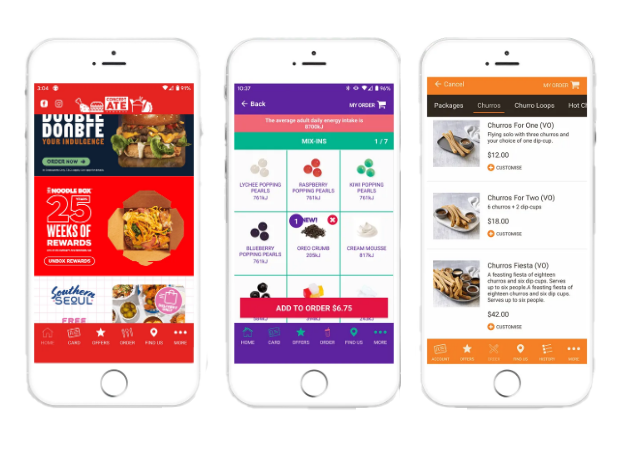
The size of the prize is real and customer-attested. Concept Eight — the multi-brand QSR group behind Noodle Box, Wokinabox, Pattysmiths, Supreme Leader, Alabama Wings, Double Dragon Dumplings and Supreme Noodles — measured a roughly A$15 increase in average transaction value, per order, from loyalty customers on the Redcat App. CEO Grant Lee: “the ATV has increased by about $15 per order.” That compounds across every loyalty-recognised order, across every brand, across every channel — exactly the surface a fractured stack hides from you.
Concept Eight also recovered roughly 15% of aggregator commission by routing direct orders through Redcat-enabled white-label delivery. Your specific uplift will depend on channel mix and category, but the direction and magnitude are consistent enough and any optimisation here directly improves operating margins.
Why this is an immediate problem?
Three things have converged for senior leaders in QSR-AU that have created urgency across the industry.
Aggregator margin pressure. Direct-channel economics matter more than they did a year ago. Loyalty is the lever that pulls demand back direct — but only if the data is unified enough to make a recognisably better offer than the aggregator does.
Multi-site rollout is the growth path. Most operators we work with are scaling from 5–10 sites with aggressive growth plans. Every new location built on a fractured stack inherits the integration debt, and the problem is compounded
Timing matters. There are busy times of the year that are off limits for any sort of disruption to the tech stack. Operators are working with narrow windows each year to affect change. If they haven't planned in advance, they run the risk of another year with the same recurrent issues.
What “one system” actually solves
Consolidation gets overused as a term, so it’s worth being precise. We don’t mean replacing every tool you own with one mega-product. We mean a single source of truth — one customer record, one menu, one transaction stream — with specialist tools sitting on top of it rather than beside it.
Practically, that means:
- Channel consistency — same menu, prices, and loyalty status in-store, in-app, on the website, and through the aggregator.
- Real, comparable data — same definitions, IDs, and reporting period across every channel.
- A loyalty engine that sees the whole customer — every transaction across every channel feeds the same programme.
- Faster location rollout — new sites inherit the configuration, not the integration debt.
- Operational hours back — the 10–15 hours a week of reconciliation simply doesn’t need doing.
Where to go from here
Based on the multi-location brands we work with across Australia, including Nando’s, Boost Juice, Chatime, Concept Eight and San Churro, we would like to help you to quantify the opportunity for your business.
- Diagnose: We can support you to run a 90-minute self-audit. You’ll know very quickly where the opportunity lies and whether a new system is going to make sense for your business
- Quantify your specific cost: We can help to calculate the commercial impact of a fractured tech stack, by assessing lost time and revenue through operational inefficiencies, missed loyalty redemptions, channel leakage, aggregator dependency and so on.
- Decide on the right timing: We understand that change is not easy, and will build a project plan that works for you and your business
 Steve Clement